Address
304 North Cardinal St.
Dorchester Center, MA 02124
Work Hours
Monday to Friday: 7AM - 7PM
Weekend: 10AM - 5PM

Address
304 North Cardinal St.
Dorchester Center, MA 02124
Work Hours
Monday to Friday: 7AM - 7PM
Weekend: 10AM - 5PM

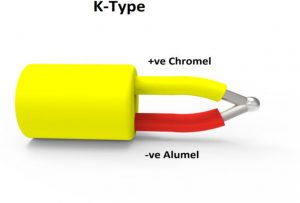
Type K Thermocouple provides widest operating temperature range. It consist of positive leg which is non-magnetic and negative leg which is magnetic.In K Type Thermocouple traditional base metal is used due to which it can work at high temperature and can provide widest operating temperature range. One of the constituent metal in K Type Thermocouple is Nickel, which is magnetic in nature.
The characteristic shown by K Type Thermocouple is that they undergo a deviation in output when magnetic material reaches its Curie Point, at around 185 °C. K Type thermocouple work very well in oxidizing atmosphere at temperatures up to 1260°C (2300°F) and its tolerance class is ± 1.5 K between -40 and 375 °C.
The K-type thermocouple itself does not have a specific Curie point temperature. The Curie point refers to the temperature at which a magnetic material loses its magnetism. The K-type thermocouple is a temperature sensor composed of nickel-chromium alloy (positive pole) and nickel-silicon alloy (negative pole), and its working principle is based on the thermoelectric effect, which has nothing to do with magnetism. Therefore, the K-type thermocouple does not have the characteristic of a Curie point. However, it is worth noting that the negative pole of the K-type thermocouple (nickel-silicon alloy) may undergo a magnetic transition within the range of 150 to 200°C. This transition may affect the performance of the thermocouple within this temperature range, especially when used in a magnetic field, where time-independent thermoelectric potential interference may occur. But this magnetic transition is not equivalent to the concept of a Curie point.
In K Type Thermocouple positive leg is composed of 90% nickel, 10%chromium and a negative leg is composed of 95% nickel, 2% aluminum, 2% manganese and 1% silicon. These are the most common general purpose thermocouple with a sensitivity of approx 41µV/°C.
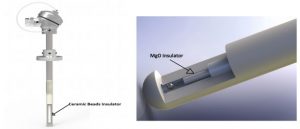
In Type K Thermocouple mainly two type of insulation is used firstly Ceramic beads insulation is used as it is a lightweight insulating product. It is made from high purity alumino-silicate materials. It has low thermal mass which means that it does not retain heat, low thermal conductivity and is an extremely effective insulation material as it can withstand high temperature of 1260 °C so it it best suited material for Type K thermocouple.
Secondly compacted mineral insulation and outer metal sheath (MgO) is used. Magnesium Oxide has a high dielectric strength, responds quickly to temperature changes and is very durable. It has typical Composition of the Standard Quality MgO (97%) and the High Purity MgO and AI2O3.
Magnesium Oxide insulation is recommended for K Type thermocouple when Thermocouple are to be immersed in liquids, high moisture, corrosive gases or high pressures. The thermocouple can be formed to reach otherwise inaccessible areas.
To find appropriate range of thermocouple we should use appropriate wire because different wires measure various temperature ranges. Of the four major thermocouple types, type K covers the widest range :–

EMF Vs Temperature Graph for K Type Thermocouple
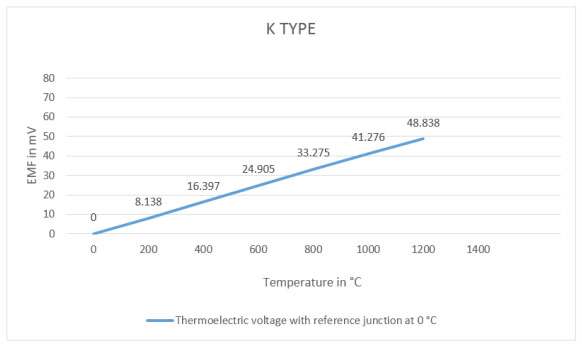
They are mostly used for applications at temperatures above 550 °C up to the maximum working pressure of the thermocouple.